
Gama Network Presents:
From Casual to Core
A Statistical Mechanism for Studying Gamer Dedication
By Barry Ip and Ernest Adams
Gamasutra
June 5, 2002
With the increasing popularity of interactive entertainment and its acceptance as a form of popular culture, the average gamer is no longer a stereotypical geek and obsessive hobbyist. If the game industry is to further broaden gaming's appeal to mass-market audiences, it must learn to fulfil its
customers' desires, but there is still a great deal of uncertainty about who they are and what they want. Unfortunately, the industry does little formal market research. Publishers tend to rely on focus groups, warranty-card returns, and Internet gossip to understand the state of the market.
These mechanisms have the advantage of being inexpensive, but all are compromised by the fact that
their participants are self-selected and almost certainly atypical consumers. Focus groups and Internet messages also represent extremely small samples on which to base important decisions, and much of their content consists of unquantified observations. In his eight years of employment at Electronic Arts, Ernest Adams never saw a single document offering a quantitative statistical analysis, backed up by a properly-conducted poll, of the state of the market.
Notably highlighted by Ernest Adams' Designers Notebook entry "Casual vs. Core" and Scott Kim's GDC 2001 presentation "Designing Web Games that Make Business Sense", professionals in the game industry tend to think of gamers as falling into one of two categories -- the hardcore and the casual. The characteristics that define these categories are usually vague and based on intuition and personal experience. We often hear the terms hardcore (also referred to as core, or traditional, gamers) and casual (mainstream, mass-market, and occasional gamers) being used freely by journalists, reviewers, and various gaming-related media, while failing to define precisely what it means to be one or the other. In this article, using a combination of relevant discussions and certain principles of consumer classification from academia, we shall propose a method for statistically distinguishing between different categories of gamer according to quantifiable criteria. Studies of consumer behaviour widely acknowledge the concept of consumer segmentation, and the importance of accurately targeting different types of customer. Consequently, knowing the preferences and idiosyncrasies of the most important entity in the industry -- the gamer -- takes us halfway towards the goal of total customer satisfaction.
Gamers can be described by a nearly infinite number of characteristics. Following the suggestions of Adams and Kim, we propose 15 variables that we believe are key to distinguishing between the hardcore and the casual gamer, and ways of measuring each for a given player. Once these data are gathered, they may be weighted to obtain a single numeric score, which determines the extent to which the player is a "core" or a "casual" gamer -- a value that we call gamer dedication.
The 15 Factors of Classification
Hardcore gamers are clearly different from casual gamers, and the characteristics of hardcore and casual gamers will also be different from those who are generally uninterested in interactive entertainment. Therefore, understanding the opposing ends of the spectrum, and the space in-between
, with regard to consumer preference, opinion, knowledge and behaviour, is critical for the purpose of establishing any sort of gamer classification. Taking the characteristics mentioned by Adams (2000) and Kim (2001), as well as introducing a few of our own, the following discussion of The 15 Factors of Classification takes into account the most pertinent factors associated with the distinction between the different types of gamer.
Hardcore gamers are: (taken from Kim)
1. Technologically savvy
2. Have the latest high-end computers/consoles
3. Willing to pay (also supported by Adams)
4. Prefer violent/action games
5. Prefer games that have depth and complexity
6. Play games over many long sessions (also supported by Adams)
Hardcore gamers: (taken from Adams)
7. Hunger for gaming-related information
8. Discuss games with friends/bulletin boards
9. Play for the exhilaration of defeating (or completing) the game
10. Much more tolerant of frustration
11. Engaged in competition with himself, the game, and other players
Other:
12. Age at which first started playing games
13. Comparative knowledge of the industry
14. Indications of early adoption behaviour
15. Desire to modify or extend games in a creative way.
Table 1: The 15 Factors (not in any particular order)
Discussion
In each case we suggest a method for measuring these characteristics quantitatively.
- Technologically savvy More or less self-explanatory, we expect hardcore gamers to be more
familiar with the latest releases and developments, and to show greater interest with regard to new gaming-related technologies as compared to casual gamers. This characteristic can be measured by presenting survey subjects with a large number of computer-game technology terms and acronyms, and asking them to match the term with its correct definition. This will provide a numeric score for the subject's degree of "technology savviness."
- Have the latest high-end computers/consoles Hardcore gamers will acquire the latest console platforms and/or PC hardware in order to keep up-to-date with the most recent trends. Furthermore, they are more likely to own, or have owned, a wide variety of older games platforms
. Subjects may simply be asked which console platforms they own; in the case of PC gamers, what the performance characteristics of their machines are.
- Willingness to pay - A factor acknowledged by both Adams and Kim, hardcore enthusiasts are more inclined to spend money on games and games-related products. Conversely, casual gamers
are more inclined to wait for price discounts and special offers before committing to a purchase. Kim further emphasises this point with the characterisation of casual gamers as "wanting games for free". This can easily be measured by asking survey subjects about their spending patterns.
- Prefer violent/action games Kim suggested that hardcore gamers prefer games that show comparatively violent and action-intensive content. However, should a more generalised terminology be required, we could re-phrase this to obtain a measure for a gamers' comparative preference for certain types of game, rather than solely for action/violent games. Because the
definitions of "violence" and "action" are subjective, controls could be established by asking subjects about their preference for specific games, with the games divided into categories based on their Entertainment Software Rating Board descriptors.
- Prefer games that have depth and complexity Complementary to factor 4 above, hardcore gamers prefer games that deliver greater complexity, and which require a longer time to master, regardless of their themes. This can be objectively measured by asking subjects whether they prefer a game that takes more or less than a given amount of time to play through.
- Play games over many long sessions A factor supported by both Adams and Kim. Being the hardcore gamers' favourite hobby, they are likely to devote considerably more time playing games as compared to casual gamers. Subjects can be asked about their playing patterns.
- Hunger for gaming-related information Devouring everything from the latest news, previews and reviews, to interviews with industry experts, the hardcore gamer actively seeks gaming-related information through the Internet, games-magazines and books, etc. Subjects may be
asked how much time they spend per week on these activities.
- Discuss games with friends/bulletin boards In addition to hunger for information (factor 7), hardcore gamers like to discuss gaming with others, and to regularly visit game-related Internet
forums or chat rooms. Subjects may be asked how much time they spend per week on these activities.
- Play for the exhilaration of defeating (or completing) the game Hardcore gamers will play persistently for the enjoyment and exhilaration of defeating the game, and are likely to be more
forgiving of aesthetic flaws such as poor acting or a trivial plot. This can be measured by asking subjects to rate the relative importance to them of a number of factors in their motivation for continuing to play a given game (not for choosing to purchase the game). If "I want to beat/finish it" is considered highly important, the subject is more likely to be a hardcore player.
- Much more tolerant of frustration Hardcore gamers are much more tolerant of difficult games, or games that might frustrate them in some way. Casual gamers are more likely to abandon such games. The best way of measuring this quality objectively would be to present all the subjects
with the same, moderately frustrating or difficult game, and measuring the length of time they play before abandoning it.
- Engaged in competition with himself, the game, and other players Hardcore gamers want to feel the satisfaction and reward of competing and improving his skill against other players and/or
computer-controlled opponents. Casual gamers would not, for example, be inclined to play endlessly to their reduce lap-times in Gran Turismo by a fraction of a second, or have the patience to learn every combination attack in Street Fighter, or even to achieve a higher score. Subjects can be asked to rank a number of factors in their decision to continue to play a game. If improving her skills, competing with others, or achieving the highest score (whether above those
of other players or her own previous efforts), are ranked as important, this would tend to suggest that the subject is a hardcore player.
- Age at which first started playing games Evidence from respectable sources such as the IDSA and ELSPA indicates that the gaming audience is growing older. One of the reasons for this is
that those who started playing at a young age have gradually matured alongside the development of the industry. Taking this into consideration, this factor takes into account the extent to which they are familiar and experienced with playing games. This can be quantified by asking subjects at what age they started playing games as a hobby. If they started at a young age, and have since been regular gamers, then this would indicate those who are more experienced and knowledgeable.
- Comparative knowledge of the industry Complementary to factors 7 and 12 above, hardcore gamers are likely to posses a much greater level of knowledge and experience with regard to the various facets of gaming (of ranging from knowledge about the latest releases, to design issues
and developments within the industry). However, the hunger for information (factor 7) does not directly translate into a good knowledge base. For example, a casual gamer may consider himself hungry for information, but only towards certain things (such as latest releases, reviews and prices). The hardcore gamer, on the other hand, is likely to show broader knowledge and awareness of industry activities and trends, new technologies, and game development methods.
Subjects can be asked to classify a number of statements about games and the game industry as true or false. Those who classify a large number correctly can be said to be comparatively more knowledgeable and aware.
- Indications of early adoption behaviour Early adoption behaviour (EAB) as defined in consumer-marketing literature, is an undeniable and salient characteristic that defines the behaviour of
consumers. EAB describes consumers or individuals who are first to adopt the latest in trends or fashions. Current theory suggests consumers who exhibit EAB do so in order to establish themselves as part of an innovative and desirable social hierarchy (see, for example, Fisher and Price, (1992)). In terms of the games industry, this describes the behaviour of hardcore gamers, who are willing to spend exponentially more on new hardware and software that are yet to be
released officially (through grey-market imports) in order to satisfy their hobby. In addition, for hardcore gamers (particularly those in the UK), the detrimental effect of localizing games from the NTSC broadcasting standard (US and Japanese markets) into PAL (UK) further strengthens the demand and reason for importing NTSC games directly. (Localized games converted from NTSC to PAL typically exhibit slower game speeds, unsightly screen borders, and less attractive packaging.
) Furthermore, hardcore gamers would not necessarily acquire imports or gaming-related items solely for the purpose of overcoming the delay of official releases, but also to possess items that have a rare or intrinsic value. Consequently, this factor attempts to obtain a measure of EAB from the various categories of gamer. Subjects can be asked a number of questions about EAB, such as whether they have ever waited in line before a software store opened to buy a new game on
its first day of release, and if they regularly acquire imports. Those who answer a number of these questions affirmatively can be said to be "early adopters" and therefore probably hardcore gamers.
- Desire to modify or extend games in a creative way Hardcore gamers frequently modify commercial games in a variety of ways. These can range from simple changes such as giving characters new "skins" to cause their appearance in the game to be different, to programming "aim-bots", separate pieces of software that work in concert with an existing game to give the player an unfair advantage over others. Casual gamers seldom take the time to make these kinds of modifications; they tend to play the game "as-is" out of the box. Subjects can be asked whether they have ever engaged in some of these activities. The more that they have, the more likely they are to be hardcore gamers.
Weightings
Clearly, some of the factors mentioned above are more important than others. For example, a factor such as "play over long sessions frequently" is more important, than say, "prefer games that have depth and complexity." The latter is merely an individual preference with regard to the design of the game,
and not the degree to which gaming is pursued as a hobby. In order to take into account this varying degree of importance, weightings should be attached to each factor during classification (where higher weights indicate greater relative importance). Moreover, in applying the classification procedure, weightings can be determined arbitrarily according to the importance the marketer perceives them to
hold for his own purposes. Table 2 below shows the 15 Factors and their corresponding weightings according to our interpretation of their degree of importance.
Factor | Weighting |
1. Play games over many long sessions | 10 |
2. Discuss games with friends/bulletin boards | 10 |
3. Comparative knowledge of the industry | 10 |
4. Much more tolerant of frustration | 9 |
5. Indications of early adoption behaviour | 9 |
6. Desire to modify or extend games in a creative way | 8 |
7. Technologically savvy | 7 |
8. Have the latest high-end computers/consoles | 7 |
9. Play for the exhilaration of defeating (or completing) the game | 7 |
10. Hunger for gaming-related information | 6 |
11. Engaged in competition with himself, the game, and other players | 6 |
12. Willingness to pay | 5 |
13. Prefer games that have depth and complexity | 3 |
14. Time started playing games relative to the age of the industry | 2 |
15. Prefer violent/action games | 1 |
Table 2: The 15 Factors of Classification and associated weightings
(ranked according to weight)
Calculating Gamer Dedication
Application of the 15 factors requires the use of measurement scales with which to record the responses given by the subjects. There are many varieties of measurement scales, each with their own
unique advantages and disadvantages, and varying levels of complexity. For this example, we have decided to assume that the raw data for each factor will be normalized to a scale of 1 to 5. This corresponds to the familiar Likert scale, widely used in questionnaire and survey experiments, in which subjects are asked whether they "strongly disagree," "disagree," "neither disagree or agree," "agree," or
"strongly agree" with a series of statements.
Suppose that gamer X provided the following normalized data for the 15 factors:
Factor | Weighting | Normalized Data |
1. Play games over many long sessions | 10 |
3 |
2. Discuss games with friends/bulletin boards | 10 | 4 |
3. Comparative knowledge of the industry | 10 | 4 |
4. Much more tolerant of frustration | 9 | 5 |
5. Indications of early adoption behaviour | 9 | 4 |
6. Desire to modify or extend games in a creative way | 8 | 5 |
7. Technologically savvy | 7 | 3 |
8. Have the latest high-end computers/consoles | 7 | 4 |
9. Play for the exhilaration of defeating (or completing) the game | 7 | 2 |
10. Hunger for gaming-related information | 6 | 3 |
11. Engaged in competition with himself, the game, and other players | 6 | 2 |
12. Willingness to pay | 5 | 3 |
13. Prefer games that have depth and complexity | 3 | 2 |
14. Time started playing games relative to the age of the industry | 2 | 2 |
15. Prefer violent/action games | 1 | 1 |
Table 3: Data obtained from gamer X
From the above information, the overall gamer-dedication score (GD) can be calculated as:
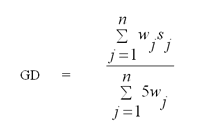
Where n=15; s = self-ranked score; and w = weight
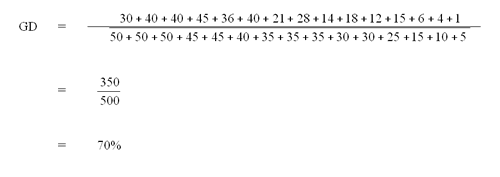
GD for gamer X is therefore:
Interpretation
As mentioned earlier, the weighting attached to each factor is arbitrary depending on the person using
them. However, further research (such as an extensive survey or poll to obtain the views of industry experts or gamers themselves) could be conducted in order to establish standardised weightings. From these, one can easily obtain measures from individuals regarding their overall attitude towards gaming. It is reasonable to assume that the higher the overall score, the stronger the evidence for classifying a
person as a hardcore gamer and vice versa. However, the most teasing concern remains to be one of delicate and accurate interpretation of overall scores, particularly those which are neither leaning towards the casual or hardcore segment. In the absence of actual data, we hypothesize the existence of five possible categories that a person can potentially fit into based on their score. Diagram 1 below illustrates this.
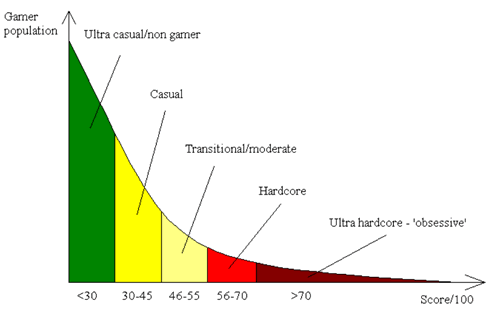
Figure 1: adapting overall gamer-dedication scores obtained using the 15 Factors of Classification into customer segments:
Ultra casual or non-gamers. A person obtaining a low score from the 15 Factors of Classification could be a casual gamer or even a non-gamer. "Ultra casual" gamers have great potential for further exploitation; they have clearly demonstrated at least some interest in gaming. However, much needs to be done to determine the factors that turn the "ultra casual" into the "casual". Gamers included in this category, could, in theory, incorporate any section of the demographic ranging from 8 year-olds to old-age pensioners. As long as the person has some kind of experience with games or interest in them, he or she is likely to be a potential customer. Non-gamers may or may not be potential customers; it depends on whether the reason that they don't play at the moment is a total disinterest and rejection of games, or a lack of information and opportunities to play. Further survey questions could distinguish between these groups, and those subjects who do not and will not ever play should be eliminated from the dataset.
Casual. With a higher score than the above category, but lower than that of the preceding ones, casual gamers show a mild response to the 15 Factors. Casual gamers are not ignorant or indifferent about games, but simply show a reserved level of interest.
Transitional/moderate. Not to be confused with other categories, the "transitional/moderate" segment is used to describe those who obtained a relatively neutral score. There are potentially two types of gamer who reside in this category. "Moderate" gamers would generally have greater knowledge and experience of games than the preceding categories, but don't necessarily have the latest games or keep up with news about the game industry itself. The term "transitional" is used here to describe gamers who obtained a relatively neutral score because their habits are in transition from the "casual" to the "hardcore" segment, or vice versa.
Hardcore. Those with consistent scores for all 15 factors show a strong indication of being a hardcore gamer. These gamers are likely to possess greater gaming-related knowledge and experience, as well as spending considerably more time and resources on games than the preceding categories.
Ultra hardcore (obsessive). Few gamers fall into this category. However, those who do are likely to take the hobby of gaming very seriously, and devote significant resources to it - even more so than "hardcore" gamers.
The proportions of each of the gamer-segments shown in Figure 1 are merely estimates. The real significance of the diagram is that it demonstrates that gamer dedication is a continuum, not a dichotomy. We think it likely that there are five useful categories of gamer, though an actual poll may reveal more or fewer in the form of peaks in the graph. It seems probable that the categories of "ultra casual" and "casual" comprise the largest population of gamers, as compared to "transitional/moderate", "hardcore" and "ultra hardcore" gamers.
Clearly, more work is required in several areas:
- A proper survey must be designed with suitable questions that yield unambiguous quantitative results.
- If gamer dedication is to become a standardized measure for marketing purposes, then standard weightings for each of the 15 factors must be agreed upon by the game marketing community.
- The results of an actual poll must be studied in order to determine how many useful categories of gamers there really are, and what their scoring intervals are.
- Once a useful and group of gamer categories has been identified, the next step is to determine how important each category is to the industry. Once this is achieved, effective strategies can thus be developed to attract the appropriate customer segments.
- Once these steps have been taken, much research needs to be done in order to establish the probability of gamers migrating from one segment to another, and the causal factors leading to such behaviour. Whether or not the five consumer-segments we have proposed really exist, we are confident that certain patterns will emerge from a proper study - ultimately exemplifying the variation in consumer tastes and attitudes towards interactive entertainment.
Conclusions
In this article, we have discussed the key differences that exist between different types of gamer. The 15 Factors of Classification takes these factors into account, and offers a way to empirically categorise various types of gamer, and highlights the areas requiring further research. We hope that we have
successfully expanded on some of the issues regarding the customer, and reasons why the concept of customer segmentation is a useful exercise. While many unanswered questions still exist, we can at least begin to take the first steps towards knowing and understanding our customers on a proper statistical basis rather than through anecdotal evidence, hunches, and personal experience. As new generations of hardware heighten customer expectations to new levels, it becomes imperative that we
develop games that satisfy their expectations. Formally identifying the various categories of gamer will help us to develop games that do so.
Ultimately, the prosperity of the industry depends on our ability to meet the desires of as many of our customers as possible. In the future, customers might voice their likes and dislikes, and games can be
tailored according to their wishes. In an increasingly heterogeneous marketplace, customisation may be a key to customer satisfaction. Mass-customisation is not a viable option for the industry, but in a diversifying market, we should not rely on a one-size fits-all mentality. While licences, sequels, and the me-too approach may attract the "ultra casual", "casual", and possibly even "transitional/moderate"
gamers, the emphasis on producing truly captivating content to satisfy the "hardcore" and "ultra hardcore" must remain. And, bearing in mind that there is no evidence to suggest that the degree of customer importance is proportional to the number of gamers in each of the respective categories, great care needs to be placed on deciding what games are developed, and if they are aimed at the
right categories of customer. With development costs rising, we can ill afford to disappoint customers through a poor understanding of the market, and given the amount of talent and resources in the industry, there is absolutely no reason why this should be the case.
References
Adams, Ernest (2000), "The Designer's Notebook: Casual versus Core", Gamasutra.
Kim, Scott (2001), "Designing Web Games that Make Business Sense", Game Developers' Conference 2001 Proceedings, San Francisco: Game Developers' Conference, 423-31.
Fisher, R. and Price, L. (1992), "An Investigation into the Social Context of Early Adoption Behaviour", Journal of Consumer Research, 19, (3), 477-86.
Copyright © 2000-2001 CMP Media Inc. All rights reserved.